
Education
General guidelines
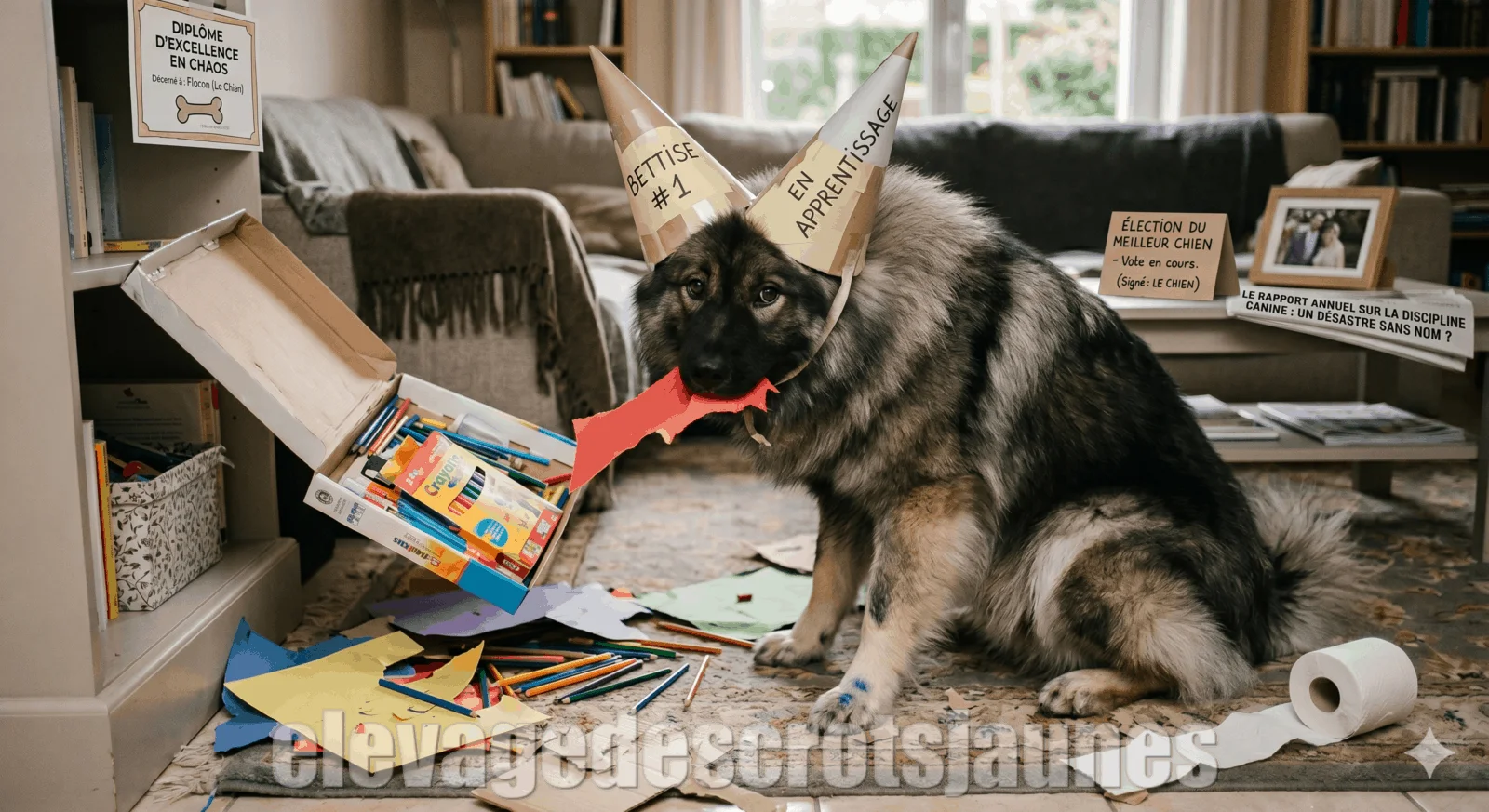
The Education of the Eurasier: Between Gentleness and Conviction
The Eurasier possesses a rare intelligence that makes its training fascinating. Responsive and naturally inclined to please you, it transforms each session into a moment of complicity. However, it would be a mistake to confuse its docility with a pre-acquired flexibility. Its ease of understanding should never be an excuse for laxity: this breed requires early, firm, and consistent education.
Precocity is the cornerstone of its adult life. From the start, it is essential to establish a clear framework where what is forbidden remains so every day. But beware, this firmness must never be brutal. With an extreme sensitivity, the Eurasier completely shuts down in the face of violence. An unjustified cry would break this precious bond of trust that we establish in breeding. To get the best out of it, bet everything on positive energy: nothing beats sincere encouragement and rewards given with enthusiasm.
Be for him a benevolent guide: he does not seek a boss, but a leader who inspires him.
Our Principles in Daily Life
Succeeding in educating your Eurasier is primarily about building a mutual respect relationship so that our puppies grow into calm adults.
🧘♂️ Serenity, Patience, and Progression
The dog is like a sponge: it feels your state of mind. To accompany it, always prioritize calm. Do not rush anything; education should never be done in agitation. Make sure an acquired skill is perfect in the garden before testing it in the field. Respect the order of learning (sit before down) and progress only when the basics are solid.
✨ Joy and Clarity of the Message
Your Eurasier learns not out of obligation, but to please you. Celebrate each success with a smile and a happy voice. To be well understood, give short and precise orders. Avoid long sentences like "Come my darling, see mommy, come sit down!": your companion would soon realize you are not in a hurry. For recall, squat down and call him with an enthusiastic voice; your enthusiasm must be stronger than all distractions.
👶 Psychology and Maternal Firmness
A 5-month-old Eurasier remains a baby in a large body. Do not despair in the face of forgetfulness or the 9-month-old adolescence tests. However, be firm if it clearly taunts you. In these moments of rebellion, act with the assurance of a mother: a firm hand to stop the movement, combined with a brief and grave vocal signal, often suffices to restore calm. The goal is to stop the interaction until full calm is restored. It is this secure framework, without anger but without weakness, that your dog naturally understands and respects.
🐺 The Pack's Balance
If you own several dogs, respect the natural hierarchy. The dominant should always be petted, groomed, or taken out first. Never scold the dominant if a subordinate has provoked it: if a puppy bites an older dog, it is the young one that should be corrected. It takes self-discipline to maintain the group's balance.
Consistency and Autonomy
The meaning of a word is acquired through learning, but your gestures must match your words. Remembering your dog with anger or touching its bowl with fear breaks trust. Finally, don't forget the detachment step around 6 months. Just as its mother pushes it away to teach independence, you must encourage its autonomy. A dog that can stay alone without anxiety is a well-adjusted dog.
Dominant ou non!
🐺 The Wolf, Its Nature and Its "Human" Family
If you have observed your puppy well during our meeting, you already have a good idea of its general temperament. However, nothing is set in stone: a puppy is malleable, and it is up to you to shape its disposition, for better or worse, according to the framework you provide.
The vital need for a reference point
The dog remains a social animal for whom structure is synonymous with balance. In its world, stability comes from those who make decisions, show the way, and ensure the safety of the group. By integrating your home, your companion must find this guide among your human family. From the very first days, it will instinctively know who is consistent and with whom boundaries can be tested.
🚫 Exit anthropomorphism
Many are worried today about the notion of hierarchy, fearing the establishment of an authoritarian regime. This is, however, a fundamental mistake: if we do not treat a child like a dog, the opposite is equally true. A dog, regardless of its breed, remains a canid that needs clear rules to thrive.
🛡️ A framework for its security
In our time, our companions have become full-fledged members of the family. But be careful not to attribute purely human intentions or feelings to them. Giving them a framework is not a punishment, it's giving them security. Depending on whether your puppy is more assertive or more reserved, your role as a leader will be more or less solicited, but it must remain indisputable for its well-being and serenity.
Cleanliness
Here is a tip given by Joseph Tindille, an Akita breeder (From La Lettre du Chien - April 96)
"I submit to you a method that works in 90% of cases to ensure that the puppy is clean in its new home from the first day (except for nighttime accidents). When a client leaves with their puppy, we ask them, upon arrival, not to let the puppy enter the apartment directly but to keep it outside for 10 to 15 minutes, during which the puppy will relieve itself after the car ride. Then, clearly praise the animal and give it a small treat. The puppy will understand that the 'thing' must be done outside, not in the apartment. [...]
In any case, you should regularly take the puppy out after naps and meals, about every hour during the first week of its arrival. Show your satisfaction when it relieves itself outside and don't be afraid to overdo it: exaggerate your joy during the potty break so that the puppy associates your joy with its action. [...]
If you see the puppy pacing around the house, take it outside quickly. However, if it forgets, immediately scold it and take it outside for the rest of the time (always with the clowning sequence if the rest of its needs are taken care of outside). Once the mess is cleaned up, bring it back inside, but don't let it see you on all fours cleaning up, as it might take it as a game to repeat.
This association of actions and gestures should be effective after 15 days. Do not scold your puppy if you find a potty accident upon your return; he no longer remembers that it was him who did it even though he looks guilty: it is your tone of voice that makes him lower his ears, not the memory of his misdeed that he has forgotten! Try this with a glass of water spilled in a corner of the room and scold your puppy; you will see him flatten himself even though he did nothing.
A final little tip: when you take your puppy out for his needs, wait for him to go and bring him back immediately; this way, he will make the difference between hygiene outings and play. If you leave him outside, he will associate "potty at home = running in the garden = to be repeated!"
A puppy of 4 or 5 months may still have occasional accidents, which is perfectly normal. However, if the situation persists at 7 months, it is time to ask the right questions.
Be mindful of the signs: if your companion comes in from the garden to generously water your carpet while looking you in the eye, you don't need to be a mind reader to understand that the "education" chapter must be revisited urgently!
🎓 Learning the "Sit" Command: The First Step toward Trust
If there is one gesture that all trainers should teach, it's the "Sit"! It's the basic command that reinforces your position as a guide in daily life. More than just an exercise, it's a valuable tool for channeling your companion's excitement, whether for their safety in town or to structure key moments of the day.
🧇 The gentle method
Learning begins with simplicity. The Eurasier learns quickly if you use its favorite treat (a small piece of cheese often works wonders! ).
- The natural incentive : Approach the treat to its nose and gradually raise it above its head. To maintain balance and not lose sight of its target, your puppy will naturally lower its rear to the ground.
- Associate the word : As soon as contact with the ground is made, say "Sit" in a calm voice and offer the reward. There is no need to force or press on its back: repetition and pleasure will suffice to establish the command.
🥣 The bowl exercise: Learning patience
Once the gesture is understood, use mealtimes to reinforce self-control. Facing his bowl, your puppy will be torn between his impatience and his desire to obey.
- Serve the meal only once he has sat down, even if he sits down for just half a second at the beginning.
- Gradually increase the break time each subsequent day until you achieve perfect results. This is how you teach him, gently, that you are in control.
🚦 A tool for your safety
By the age of 6 months, you can increase the challenge by adding distance or distractions. "Sit" should become a reflex before opening the car trunk, to greet visitors without a rush, or simply to put on a collar.
⏳ The secrets of success
- Progression : Do not move on to the next step until the previous one is mastered.
- Brevity : Do not overwhelm your partner. Sessions of five to ten minutes, a few times a week, suffice amply.
- Calmness : If your puppy jumps or gets too excited, wait for it to calm down (for example, after a walk) before working with it.
My advice: Be patient. While some learn in a day, others need several weeks. Your constancy and kindness are your best allies in turning this "baby" into an exemplary adult.
Dog "Stand" : Between Aesthetics and Complicity
It's just as practical to teach a dog to stay "Up" at a red light as it is to have one sit. This basic position is essential for daily care, grooming, and, of course, future canine exhibitions... er, shows!
Natural learning
This exercise begins simply during the grooming. After finishing each brushing, place your puppy on its fours and give the command "Stand."
- The rule of the half-second : At first, the position will be held for an instant, the time of a brushstroke on the back.
- The motivation by taste: With regularity and a beautiful reward (your stock of cheese is your best ally! ), progress will be lightning-fast.
🏆 Elegance in the ring
If you plan to present your Eurasier in an exhibition, know that impeccable grooming often makes the difference. Once immobility is achieved during grooming, teach it to maintain the pose while you step back slightly.
- Grace comes from pleasure: Everything must be done with good cheer. If you rush him, he will stand without any grace. If he senses your joy, he will be proud to parade and will present himself with natural elegance.
- Precision work : By taking a step back, you can appreciate the stability of its legs, which must be well parallel. With patience, you can adjust the placement of one leg without moving the entire body.
✨ The final objective
The idea is not to get a lifeless statue, but a dog that understands what is expected of him and who genuinely takes pleasure in standing out by your side.
My advice: Be always very prudent with your cheese stock so that each session remains a feast!
Le Loose Leash Walk : A Handle, Not a Constraint
One of a master's first objectives is to teach the dog to walk properly on a leash. Without education, the exuberance of a puppy can quickly turn a walk into a ordeal, or even a danger. Yet, the leash should not be a tool of torture, but an invisible thread of communication between you and your companion.
🛠️ The right equipment to get started
Learning begins early, from when the puppy arrives at around two and a half months. The choice of equipment is crucial for establishing a climate of trust and preserving the health of your little companion:
- The safety collar (martingale type): It is an excellent tool for passive security. For a sometimes "eel-like" puppy or an Eurasier whose neck is almost as wide as its head, it prevents the dog from accidentally freeing itself (crucial during the first city walks). Its design allows it to remain completely loose and comfortable as soon as the leash relaxes. Properly adjusted, it serves as a "seatbelt" without ever oppressing the puppy.
- The ergonomic harness (in the shape of a Y or H) :For exploration and relaxed walks, the harness is today the reference in terms of comfort. It completely frees the respiratory tracts and protects the fragile cervical vertebrae. It allows the small Eurasier to discover the world without any pressure on its trachea, thus promoting a gentle learning experience.
- The fixed wide fabric collar : Once the walking on lead is well mastered, a wide fabric collar with a secure buckle is ideal. Its width allows for a diffuse pressure distribution and, a crucial point for enthusiasts, it preserves the beauty and density of the Eurasier's precious fur.
- The leash (3 to 5 meters) : Ideal for giving the puppy more freedom while keeping control.
Sweetness first and foremost 👋 : No matter which tool you choose, communication and reward remain your best allies for a complicit relationship!
🧀 The Method of the "Cheese and Wine"
The first session should be enjoyable. Start in a squatting position, play with him for a few seconds, then stand up. If your puppy "sticks" to the ground or panics :
- The miracle trick : Use a small piece of gruyère to tempt it to take two steps towards you.
- Immediate victory : As soon as he advances, give him a big hug and end the session on this success.
- The Progression : Day by day, increase the distance. He will soon realize that walking beside you is synonymous with rewards and complicity.
The "Piquet" Exercise and Hierarchy
A dog should never pull you like a "jet ski." If it tugs, it's often because it has learned that "Tirer = Avancer".
- Set the marker: As soon as the leash tightens, stop abruptly. Resume walking only when it loosens or comes back to you.
- Be the decision-maker : Don't always follow the same route. Change direction, speed up or slow down randomly. It's for him to match your pace, not the other way around.
- The Detachment : Around 8 to 10 months, the walking should be smooth. You can then place the leash on its back by giving the command "At your heel." If it strays, gently bring it back. This is the final step before full freedom.
🛡️ Serenity and Security
During meetings with other dogs, stay calm. Never pull on the leash out of fear, as you might transmit your stress to your Eurasier, which could become aggressive to defend itself.
- Keep the leash loose. If your dog feels constant tension, it will think that's normal and will pull even more to try to recreate that feeling.
Freedom begins with a loose leash and a confident handler. A well-leashed dog is a dog that trusts you to choose the direction.
Doors - The Art of Welcoming: Calm and Politeness
It is always unpleasant to be suddenly jumped on, whether by one's own puppy or by visitors. This behavior often settles in when the puppy is small: it is allowed to use our legs as a jumping-off point to beg for scratches without our noticing. Yet, it is here that the boundaries begin to weaken.
🐾 Respecting personal space
In nature, we approach the reference with respect, but we never jump on top of it. If your dog puts its paws on your shoulders, it is testing your leadership position.
- The golden rule: Systematically prevent these jumps. Lay the puppy on the ground and crouch down to praise him at his level.
- Block him out : If the dog persists and grows more insistent, remain indifferent. Turn your back or raise a knee to block him out without saying a word. As soon as he returns to all fours and calms down, offer him the long-awaited caress. Ignoring him when he gets excited is the most effective lesson.
🔔 Managing Visits: Tackling the Chaos
In front of a doorbell, many dogs rush to it and bark. If you react with irritation by grabbing the leash, your Eurasier will sense your stress and perceive the visitor as a threat or a source of conflict.
- The Leash Method : To regain control, greet your guests while holding your dog on a leash, seated at your left side. If the dog stands up, gently but firmly put it back in position.
- Serenity and Distance : Keep the leash relaxed. If you feel that your companion is becoming too stressed, create some distance by gently moving him back from the entrance. Do not ask him to greet until he has calmed down and is no longer stressed.
🚫 Pitfalls to avoid
- Do not yell : Your Eurasier might interpret your shouts as barking encouragement or play, which could increase its excitement.
- Do not isolate systematically : Avoid confining your dog during each visit, as this may make it associate a guest's arrival with a punishment.
- Guests' politeness : Ask your friends not to look at or touch the dog until it is calm. This is often the hardest to achieve, but it's the key!
By remaining serene and direct, you teach your companion that visits are shared moments of pleasure. A polite welcome starts with a master who keeps his cool.
🚀 The Reminder: The Art of Being Desired
The recall is the most demanding exercise, as it is practiced at a distance. The secret lies in a simple principle: returning to yourself should always be perceived as a source of immense joy.
-cheese- Associate the return with pleasure
As soon as your puppy comes back to you, show overwhelming enthusiasm. Use caresses, a cheerful voice, and the inevitable piece of cheese.
- The "Stolen Recall" : Don't call your dog back only to go away. Call him frequently for a simple pat or treat, then send him back to play immediately ("Go, play!"). This way, he will learn that coming back to you is not the end of his freedom.
🧘♂️ Stay calm (even if you're boiling inside!)
If your partner is ignoring you, don't keep calling them. If they heard you, it's often a test.
- The posture of the invitation : Squat down to appear less imposing and call him with a loud and joyful voice. Avoid leaning forward or shouting in anger: this is a sign of threat that gives precisely no desire to return.
- The golden rule : No matter how long it takes him to come back (even if it took 10 minutes!), always warmly praise him. He must know that with you, he only risks a hug. If you scold him upon his arrival, he will associate the punishment with coming back.
Clowning around sessions
Your Eurasier knows full well that at ten meters, you have no control over him. If he starts a distance挑衅舞步:
- Indifference is a weapon: Suddenly change direction or hide behind a tree without a word. Startled by this lack of attention, your little curious one will quickly return to see where his guide has gone.
- Never run after him : He would take it as a marvelous game of chase and win every time !
🕵️♂️ Teach the puppy to watch over you
From the first walks, teach your puppy that it is his responsibility to pay attention to you, and not the other way around.
- Change direction without warning in safe areas.
- Hide briefly. Thus, even while occupied with its explorations, your "snooper" will always keep an eye on you, which will greatly facilitate its future returns to your side.
Do not expect a perfect recall after a year. Patience and repeated practice in good spirits are the keys to a shared freedom with full trust.
Respect for the garden
🌱 Gardening and Imitation: Preserving Your Borders
The Eurasier is an exceptional observer. If you value your flowers, the first piece of advice is straightforward: never garden in front of your dog.
Out of pure imitation, your companion will rush to do exactly the same thing as soon as you turn your back. Convinced that a treasure or prey is hidden beneath this freshly disturbed earth, he will quickly become a "ditch digger" of competition!
- Work in secret : If you need to weed or cultivate, do it when your dog is inside. Since he won't see the action, he will have much less reason to get interested.
The radical trick
If despite your precautions, your little rascal has already transformed your lawn into a cheese grater, there is an effective solution to discourage it:
- Place his own excrements in the holes he has just dug, then cover them lightly.
- The repelling effect : The dog hates digging where he does his business. Upon stumbling upon his own "surprise," he will instantly lose the urge to explore that spot. It's radical and very deterrent!
🏝️ Create an authorized zone
If your Eurasier enjoys digging, give him a well-defined play area of his own, and offer him a designated digging zone.
- Designate a small patch of soft earth or a sand box in a discreet corner of the garden.
- Hide some toys or treats there to tempt it to dig only there. By giving it its own "site", you indirectly protect your flowerbeds.
A perfect garden with an Eurasier requires a bit of cunning. By combining your indiscretion during your work and keeping his paws occupied elsewhere, you'll quickly regain the serenity of your flowerbeds!
🎾 The Game: Between Pleasure and Learning Boundaries
The Eurasier loves playing, but it's from its earliest age that you will teach it the rules of complicity. The base to never forget: It's YOU who take the initiative for the start and end of the entertainment.
👑 Who decides when the break is?
A dog that rushes at you or insistently brings you its ball can be endearing, but it's often a test of your leadership position.
- Be the initiator: You propose the toy and you decide when the session ends.
- The need for rest : A baby sleeps up to 20 hours a day (a lifestyle that sometimes makes me dream, I admit!). Play should be a short and intense pleasure, not exhaustion. 💤
🦷 Learning to inhibit jaw clenching
During these sessions, the puppy must learn to control its strength. If it gets upset, bites too hard on hands, or tugs at your clothes, the response must be immediate and without anger.
- The signal of end: As soon as the pressure becomes too strong, emit a high-pitched little cry ("Ouch!") to simulate the reaction of one of its range brothers. Then, abruptly stop the game: look away, cross your arms, and move away.
- The return to calm: By ceasing all interaction, you teach the puppy that biting "ends" the pleasure of play. This way, you obtain an adult dog for whom hand games remain perfectly safe, as he will know how to control his force flawlessly. 🤝
⚠️ Preserve your Eurasier's smile
Warning: Your companion's jaw is definitive only at the age of 7 months.
- No pulling games : Absolutely avoid pulling on a cloth, a rope, or a stick during this period. This could cause a prognathism (an offset between the jaws) that could be permanent.
- The stake: If it's not bothering his daily life, it would close the door to his confirmation. Be patient, power plays will wait for the end of his dental growth! 🦴
Punishments/rewards
⚖️ Understanding the Sanction: Timing and Psychology
The Eurasier is a highly sensitive dog. For your relationship to remain healthy and companionable, it is essential to understand how he perceives your reactions. The golden rule is simple: an intervention is effective only if the dog is caught in the act.
🏠 The trap of returning to calm
If you discover a mistake upon returning from work, act indifferent.
- The false sense of guilt : If you scold your puppy after the fact, it will not make the connection between its damage and the punishment, but between your return and the punishment.
- Vicious cycle : The "timid" dog behind the furniture does not express guilt, but anxiety. If it stresses at the idea of your return, it will destroy even more to soothe itself. Never punish a past act: ignore it, isolate the dog in another room, and clean up out of its sight. 🧹
🚪 Quiet Departures
If damage starts as soon as you close the door, it is often a sign of separation anxiety.
- Avoid forced goodbyes : If you show your own anxiety before leaving, your dog will sense it and destroy things to externalize its fear.
- Neither resentment nor revenge : I scream in indignation when I hear that a dog destroys out of "revenge." Resentment is a human emotion; the dog, on the other hand, knows only the present moment and raw emotion. It does not seek to harm you, it seeks to release an excess of emotion. 🚫
🍎 Reward VS Punishment: The Right Timing
- The Reward : It occurs at the end of the desired action. Compliments accompanied by caresses and cheese are your best allies.
- The Sanction : It must intervene at the beginning of the undesirable act (when it is about to occur) to be understood.
:The best punishment: Indifference
For a dog as close to its masters as the Eurasier, the most striking punishment is exclusion and indifference.
- The return to calm : If they make a mistake in front of you, express your disagreement firmly with a "NO" and put them back in their place.
- The guide's place : Do not make the mistake of going to stroke it 5 minutes later to "make amends". It's for him to come back to you, once calm, to seek his guide's安抚。这是翻译的英文版本,使用了正确的标记。
🏠 The Art of Solitude: Normalizing to Comfort
The Eurasier is a sensitive large dog who hates solitude. Yet, daily life will sometimes force you to leave. To avoid making your home a source of anxiety (and turning your neighbors into petitioners!), you must teach your puppy that your departure is not a drama, but a non-event.
🚪 The Ritual of the "False Start"
The only solution is to make your movements routine.
- The exercise for a few minutes : Leave the puppy in a room, close the door, and come back after two minutes. Do not look at it, do not talk to it, resume your activities. It must understand that you leave, but that you always come back naturally.
- Desensitize the signals: Put on your shoes, handle your keys, put on your coat... then go sit back on the sofa to read a book. If these gestures no longer mean "departure imminent," the stress won't rise. 🗝️
🧘♂️ A calm and structured return
Many masters make the mistake of turning their return into a national holiday. I am against it: it creates a dog that will push you around even before you have put down your bags.
- First, neutrality : Enter calmly. Greet your family, put down your things. Once the calm has returned, you can say: "Ah, hey, there's my favorite furry friend! Hi there, hold on a sec."
- Benefits of the ritual : By going last after everyone, your dog finds its balance. It learns that the word "Wait" is synonymous with future joy (play, walk, cuddle). It remains attentive but calm, knowing that its turn will come.
🗓️ The council for reception
If you are working, do not take a week off to welcome your baby. He is already going through the big upheaval of moving; imposing a 24/7 presence to change everything a week later would be too harsh.
- The ideal timing : Go get him on a Saturday morning. Take advantage of the weekend to start with short absences of a few minutes. This allows him to integrate from the first day that the house is a safe place, even when you're not in the same room. 🐾
Above all, no big displays or "talkfests" before you leave. Your anxiety is contagious. By remaining neutral, you transmit your trust to him: "I'm going, but I'll come back, everything is fine."
What you must not do
Warning: Isidor's Story: What YOU SHOULD NOT DO!
The big day has arrived, the little ball of fur is here! We want to give him everything, show him to the whole world, and kiss him endlessly. But beware: behind this cuddly ball hides a future adult who builds his references from the very first minute. Here is the (almost) true story of Isidor, the dog who became the king of the house... at the expense of his balance.
💤 The whirlwind of visits
Isidor arrives and it's a parade: family, friends, neighbors... He is woken up to be admired, handled, and pestered.
- my advice : A puppy sleeps 20 hours a day. Respecting its sleep is respecting its nervous system. Let it calm down on its own, without "ban and arrière-ban." Politeness starts with letting it sleep. 😴
slik of the "suspended" night
At first, Isidor was supposed to sleep in his own place. But on the first night, he cried. We gave in and took him to the guest room "just for a few nights." Result? Isidor never leaves the bed again, and by the time he is a year old, you are curled up on the edge of the mattress to avoid disturbing him.
- Benevolence : Giving him a fixed place and sticking to it is securing him. Changing the rules mid-way creates confusion.
🍕 The torment of the bowl
Isidor discovers that what's in your plate smells much better than his canned food. He pouts at his bowl, makes a grimace. We worry, we try four different brands, and in the end, we give him pizza and spoon-fed rice.
- The observation: A dog will never starve in front of a full bowl. By giving in, you are not feeding him better; you are teaching him to become a "picky eater." 🥣
🦴 The Calcium Apprentice
One thinks they are doing well by doubling the vitamin and mineral doses to make him grow fast. We listen to the neighbor and add pills... and Isidor ends up with crooked legs (pantied or knock-kneed).
- Breeder's expertise : Too much calcium is as dangerous as too little. Follow the breeder's recommended regimen: the growth of an Eurasier is a delicate balance that does not tolerate improvisation.
🏃♂️ Over-exercising while jogging
At three months, Isidor pants as he runs through the woods to follow your Sunday jog. It's beautiful, but his developing joints are crying for help. By one year, his knees are ruined.
- The golden rule: The exercise should be moderate and adapted to the age. A puppy gets tired quickly; its bones and cartilage are still "soft". Do not turn its growth into a marathon. 🏃♀️
🏠 The end of the story
At one year old, Isidor destroys everything as soon as he is alone, occupies the entire sofa, and only eats if you are on your knees. His owners are exhausted and say: "Never again a dog, it's too much of a hassle!"
Isidor is not a "bad" dog. He is simply a dog to whom we never said "no" out of love. Yet, true kindness is about offering a consistent framework. A well-educated dog is a free dog that one can take everywhere with pleasure!
🏠 Adopting an Adult: Offering a Second Chance
Life sometimes plays cruel tricks, forcing families to part ways with their companion dog. Lack of time, lifestyle changes, or educational flaws... these dogs find themselves in search of a new home. If your "Saint Bernard" heart urges you to step up and help an adult, here's how to successfully ease this adaptation.
🕵️♂️ Understanding the past to build the future
Adopting an adult, it's welcoming a story. Before giving in, ask the right questions to the previous owners or the shelter:
- Why the abandonment? (Solitude, education, temperament...)
- Does he know the children? The cats? Indoor life?
- The feeling test : The first contact should be frank. If the dog does not come to you or if the connection does not happen, do not force anything. Go for a walk together, scratch him: trust should be mutual from the start.
🧘♂️ Arrival: The Power of Kindly Indifference
This is the hardest step: you have to learn to ignore it. * Do not suffocate it: Do not spend hours comforting it to "reassure this poor dear." It is disoriented, and too much attention could increase its stress.
- Calm Immersion: Keep to your tasks. Let him explore the house at his own pace without following him everywhere. Your presence should be constant and reassuring, but not intrusive.
⚖️ Establishing the new "Code of Conduct"
From the very first day, be firm about the rules. He doesn't know yet what is allowed in your place:
- Strong personality : If it tests boundaries, don't yell. Take a firm hold of the leash, go for a walk to establish your guiding role calmly. 🧭
- The big shy one : If he hides under the table, do not force him out. Let him come out at his own pace. Praise him warmly as soon as he takes a step towards you, but without rushing him.
🐾 Coexisting with your other animals
If you already have a companion (dog or cat), the new arrival is, for now, the "novice" on the ship.
- Respect the old one : The first to arrive eats first and receives the hugs first. This avoids jealousies and fights.
- Let them communicate : If the old one grumbles a bit to put the "i" in place, do not intervene (except in case of real danger). They must sort out their codes among themselves so that the natural hierarchy sets in.
Count about a week to see if the adventure starts off well, and a good month for your new companion to feel completely at home. Adopting an adult dog is a challenge, but seeing a broken dog find its joy in life is one of the most beautiful rewards!
🚀 The Adoption of an Adolescent: Managing Adolescence and Testing Behavior
To adopt a "teenage" dog is to welcome a dog that has its physical strength but not yet all its mental maturity. It is a period of transition where it will seek to define its place with a lot of energy.
🧠 The brain in full bloom
At this age, the dog sometimes forgets his accomplishments (the recall, the sit) to explore his independence.
- Patience is gold : If he pretends not to hear you, do not get upset. Go back to basics as if he were a puppy, but with the necessary firmness for an adult.
- Spend it : A teenager has a vital need to move. If their physical needs are not met, they will use their energy to destroy or test your nerves. 🏃♂️
⚓ The anchoring of the guide
More than with a puppy or a senior dog, the adolescent needs to feel that you are a strong reference.
- Absolute consistency : If you give in once, he will exploit the opening. Be constant: a "no" on Monday must remain a "no" on Saturday.
- Selective Indifference: If he acts like a "clown" to get your attention, the best response is to totally ignore him. As soon as he calms down, reward him generously with some cheese! 🧀
🤝 Create the link through work
The teen loves to learn if there is an interest.
- Use educational play sessions to strengthen your bond. This is the best time to transform their excess energy into attentive listening.
Adolescence is a temporary storm. If you remain calm and guiding during this phase, you will end up with an exceptional adult. Do not let his provocations intimidate you; he is just trying to see if he can count on your stability!
General rule
💬 Communicating with your Eurasier: Decoding its Language
A good relationship with your "furry" friend involves learning its signals. The dog is an expert in non-verbal language; it constantly speaks to us through its body. It's up to us to become good translators to avoid misunderstandings. 🐾
🌈 Calming Signals: Defusing Conflict
The main purpose of these signals is to interrupt fear or aggression. The dog uses them to say: "I mean you no harm, calm down."
- Childhood Codes : Many of these gestures come from a puppy's repertoire to divert aggression from an adult (lying on their back, turning away, licking their snout).
- Strategic Imitation: A dog may whine or imitate a puppy's cry if it feels threatened, tapping into the natural instinct that dictates one does not attack the young. This is what happens if you chase your dog angrily: it is not "acting," it is trying to stop your aggression. 🛑
🧐 Beware of interpretation errors!
The human often interprets canine gestures with their own emotions (anthropomorphism).
- Licking : One often sees a "kiss" depicted. Yet, depending on the context, it can be a request for food, a sign of worry, or an attempt at soothing after a reprimand.
- The "apology" that is not one : If a dog licks its master after a conflict, it's not necessarily to apologize. In some cases, it's the winner who returns to the subordinate to close the interaction. Don't "soften" your dog at random, especially if it has a assertive temperament!
- The Point of No Return : If your dog adopts a submissive posture after a punishment and you continue to scold, it may become aggressive out of pure survival instinct. When the dog yields, the trainer must stop. ✋
🤝 Rites and Hesitations
The dog learns through repetition and observation. It will quickly notice your hesitations.
- If he turns over to trigger strokes instead of obeying, or acts silly to avoid coming home, he takes advantage of your leniency. Be consistent to remain clear in his eyes.
Dog Meeting on Leash
Two dogs meeting off-leash communicate much better. The leash often prevents natural movements of retreat or avoidance, which can create artificial tensions. Let them express themselves with their bodies as soon as safety allows.
Learning to read your dog is respecting its nature. By correctly responding to its calming signals, you establish a climate of trust where force no longer needs to exist. Kindness is primarily about understanding.